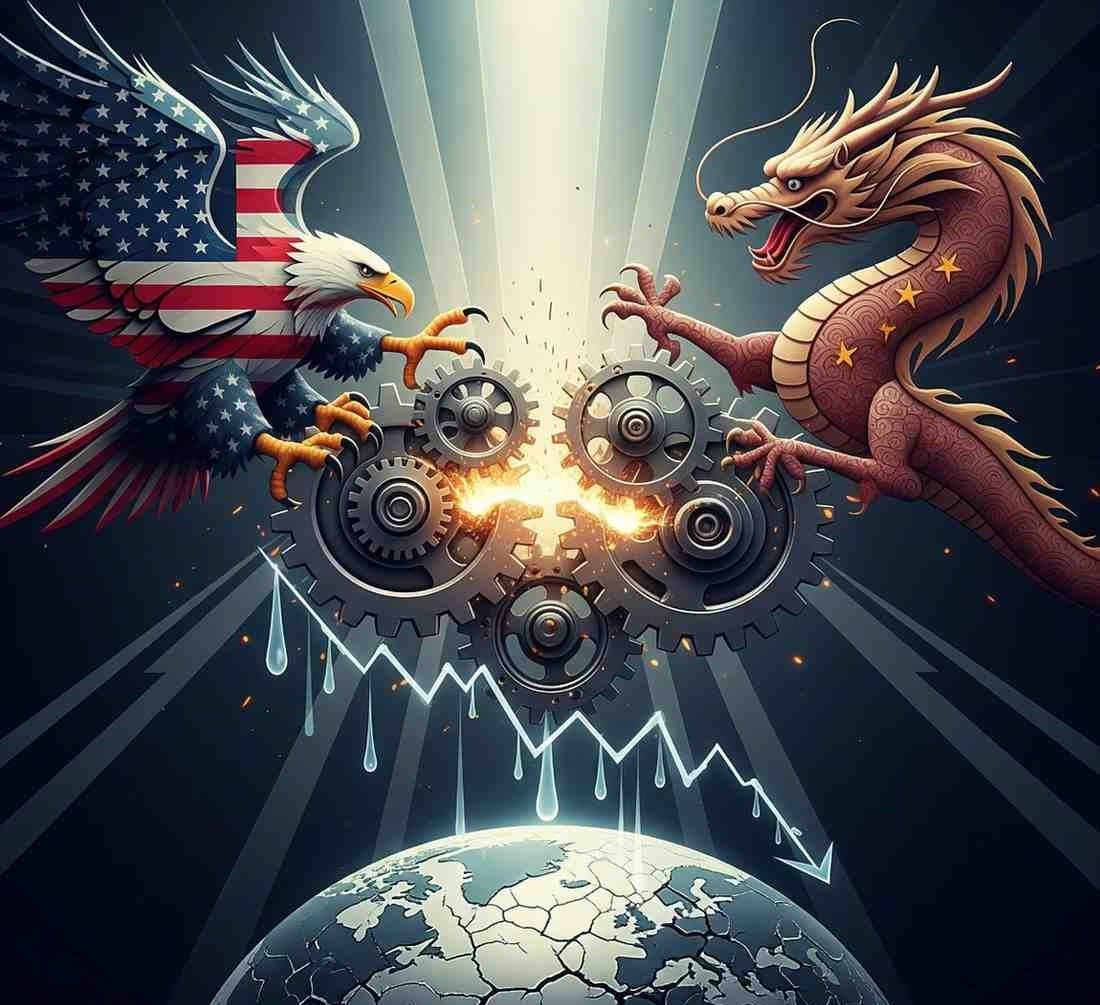
Washington / Beijing / London, Sept 11, 2025 — Business confidence has fallen to its lowest level in years as rising tensions between the United States and China intensify concerns about global trade, supply chains, and corporate growth prospects. A new survey of multinational companies found that only 45% of executives expect revenue growth in 2025, down sharply from 62% a year ago.
Trade Frictions at the Forefront
The survey highlights escalating anxieties about fresh tariffs and regulatory hurdles stemming from deteriorating U.S.–China relations. In recent months, Washington has expanded restrictions on advanced semiconductor exports to China, while Beijing has retaliated with tighter scrutiny of foreign firms and new curbs on critical minerals exports.
“These measures are creating an atmosphere of uncertainty that is already reshaping corporate strategy,” said Karen Liu, Senior Trade Analyst at Global Insight Partners. “Companies are delaying investments, diversifying suppliers, and in some cases, scaling back operations in China altogether.”
Key Survey Findings
- Revenue outlook weakens: Fewer than half of surveyed firms expect top-line growth in 2025, compared with nearly two-thirds in 2024.
- Investment slowdown: Over 58% of executives said they plan to reduce capital expenditures in China over the next 12 months.
- Supply chain diversification: More than 70% reported exploring alternative markets in Southeast Asia, India, and Latin America.
- Rising costs: Executives cited tariffs, higher compliance burdens, and logistics disruptions as top challenges to profitability.
Technology Sector Under Pressure
The technology sector has been hit particularly hard. Semiconductor makers, cloud service providers, and AI-focused firms report increasing difficulties accessing Chinese markets. Some fear that prolonged restrictions could fragment the global tech supply chain into two rival blocs — one U.S.-led and the other China-centric.
“This is no longer just a trade spat; it’s an economic cold war,” argued Jonathan Harris, Chief Economist at WestBridge Capital. “Technology, energy, and finance are being drawn into a geopolitical contest, and businesses are stuck in the middle.”
Impact on Global Markets
The confidence slump is not confined to U.S. and Chinese companies. European firms, heavily dependent on both markets, are also scaling back forecasts. German manufacturers and French luxury brands — once strong beneficiaries of Chinese demand — now anticipate slower sales growth amid cooling consumer sentiment in China and higher export barriers.
Asian economies, meanwhile, are both threatened and presented with opportunities. Countries like Vietnam, Thailand, and India are attracting fresh foreign investment as companies look to “de-risk” their supply chains.
Government Responses
Policymakers on both sides have doubled down on their positions. The Biden administration insists that its measures are designed to protect national security and reduce reliance on Chinese supply chains for sensitive industries. Beijing, in turn, has accused Washington of “weaponizing trade” and vowed to accelerate its own push for self-reliance in critical technologies.
Diplomatic efforts to de-escalate have so far yielded little progress. Recent high-level talks between U.S. Treasury Secretary Janet Yellen and Chinese Vice Premier He Lifeng ended without significant breakthroughs, though both sides pledged to maintain communication channels.
Investor Sentiment Turns Cautious
Financial markets are beginning to reflect the uncertainty. Equity indices in New York, Hong Kong, and Shanghai have seen sharp swings as investors weigh the risks of a drawn-out economic confrontation. Global fund managers report increased hedging activity, particularly in sectors vulnerable to tariffs and regulatory crackdowns.
“Markets can handle bad news, but they can’t handle uncertainty,” said Amelia Grant, Portfolio Manager at Sovereign Wealth Advisors. “Right now, companies and investors alike are flying blind when it comes to predicting U.S.–China policy direction.”
Outlook: A New Normal of Uncertainty
While most executives surveyed remain committed to the Chinese market — still the world’s second-largest economy — few expect a quick resolution to the trade conflict. Instead, many are preparing for a prolonged period of volatility.
“This is the new normal,” said Rajiv Mehta, CEO of GlobalTextiles Group, which has recently shifted part of its production from China to Vietnam. “Companies that can adapt quickly and diversify will survive. Those that remain overly dependent on a single market risk being left behind.”
📊 Bottom Line
Business confidence is faltering under the weight of U.S.–China tensions, with executives bracing for weaker growth, higher costs, and more complex supply chains. The world’s two largest economies appear locked in a long-term struggle that could reshape global commerce for years to come.