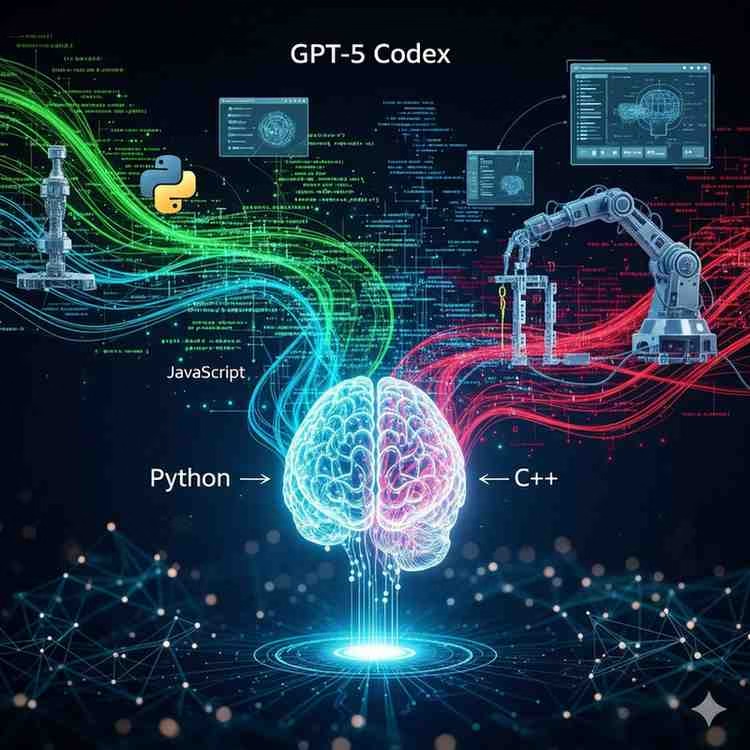
OpenAI has officially launched GPT-5 Codex, a state-of-the-art AI model designed to transform programming, automation, and intelligent agent development. This new release builds on the capabilities of its predecessors, offering multi-step reasoning, long-context editing, and advanced tool integration, making it a breakthrough for developers, enterprises, and AI enthusiasts worldwide.
The GPT-5 Codex aims to redefine the way humans interact with code, enabling more efficient software development, automation of complex tasks, and creation of intelligent AI agents that can perform sophisticated operations with minimal human input.
Key Features and Technological Advancements
The GPT-5 Codex brings a suite of innovative features that elevate AI-assisted coding to a new level:
- Multi-Step Reasoning: The model can process and execute complex sequences of instructions, allowing developers to automate multi-layered workflows efficiently.
- Long-Context Editing: GPT-5 Codex can understand and maintain context across lengthy coding projects or documents, ensuring consistency and accuracy even in large-scale applications.
- Structured Outputs: The AI can generate organized and readable code structures, reducing the need for extensive manual formatting or corrections.
- Optional Chain-of-Thought Traces: This feature provides transparency in the AI’s reasoning, helping developers understand the logic behind generated solutions.
- Tool Use Integration: GPT-5 Codex can interact with external APIs, databases, and developer tools, enabling dynamic and context-aware code execution.
These advancements make GPT-5 Codex not only a coding assistant but also a platform for creating autonomous AI agents capable of performing tasks traditionally handled by human programmers.
Applications Across Industries
GPT-5 Codex is designed to serve a wide range of industries, including software development, finance, healthcare, research, and enterprise automation. Its capabilities enable:
- Enhanced Productivity for Developers: Automating repetitive tasks, debugging code, and generating boilerplate code can drastically reduce development time.
- Intelligent Agent Creation: Businesses can build AI agents to perform customer support, data analysis, or automated reporting, increasing operational efficiency.
- AI Research and Experimentation: Researchers can utilize GPT-5 Codex to explore new AI architectures, code generation strategies, and multi-agent collaborations.
- Integration with Existing Tools: GPT-5 Codex’s tool-using capabilities allow seamless interaction with popular IDEs, cloud platforms, and project management systems.
By providing intelligent reasoning and long-context understanding, GPT-5 Codex addresses challenges faced in complex software projects, from maintaining code coherence to automating intricate workflows.
Impact on the AI and Technology Landscape
The launch of GPT-5 Codex represents a significant milestone in the evolution of AI-assisted programming. Analysts suggest that this model could:
- Accelerate Software Development Cycles: By generating code faster and more accurately, teams can reduce project timelines and costs.
- Democratize Coding: Even non-expert users can leverage GPT-5 Codex to build functional software, lowering the barrier to entry for programming.
- Advance Autonomous Systems: The model’s ability to execute multi-step reasoning and tool integration sets the stage for fully autonomous AI systems capable of handling real-world tasks.
- Enhance AI Collaboration: The optional chain-of-thought traces enable better human-AI collaboration, ensuring that developers can trust and verify AI-generated code.
This makes GPT-5 Codex a game-changer in AI development, potentially reshaping how businesses and developers approach software creation and automation.
Availability and Future Updates
OpenAI has made GPT-5 Codex accessible to developers and enterprises via API integration, allowing businesses to embed its capabilities into existing software ecosystems. OpenAI also plans to continue enhancing the model, including:
- Support for multi-agent collaboration, where multiple AI agents can work together on complex tasks.
- Expanded domain-specific toolkits for industries like healthcare, finance, and logistics.
- Improvements in context understanding and reasoning accuracy, making the AI more reliable for critical applications.
These updates ensure that GPT-5 Codex remains at the forefront of AI-assisted coding and agentic workflows.
Conclusion
With GPT-5 Codex, OpenAI has redefined the possibilities of AI-assisted coding and intelligent agent creation. Its advanced reasoning, structured outputs, and tool integration capabilities provide developers and enterprises with a powerful, versatile, and efficient AI partner.
As AI continues to integrate into every aspect of technology and business, GPT-5 Codex stands as a landmark development, bridging human creativity with machine intelligence, and setting a new standard for the future of software development and automation.