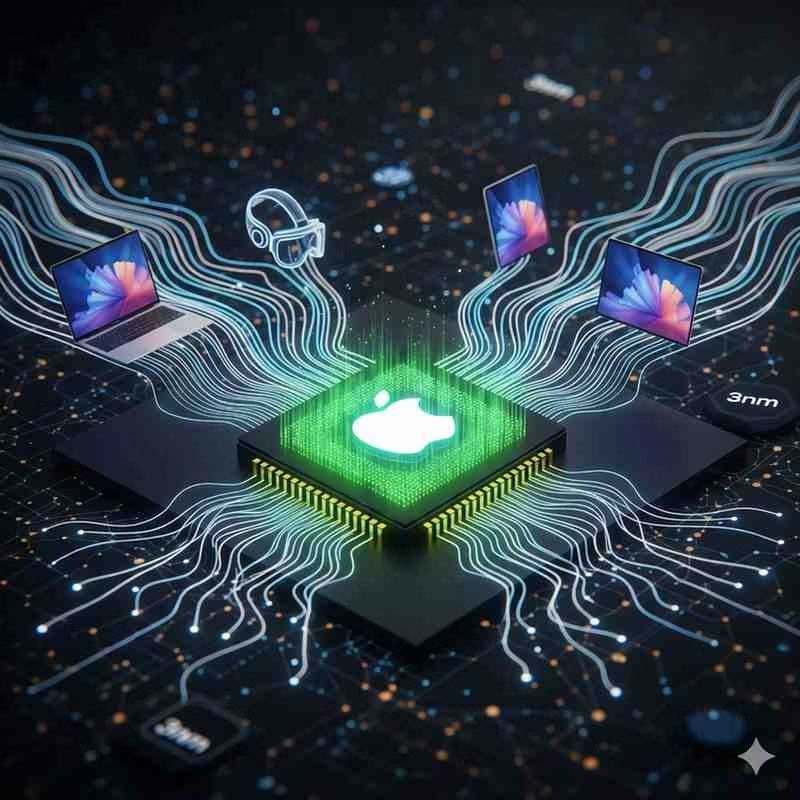
Apple has officially launched its fifth-generation Apple Silicon, the M5 chip, setting a new benchmark for AI performance, processing power, and energy efficiency. The M5 chip is integrated into the 14-inch MacBook Pro, iPad Pro, and the second-generation Vision Pro headset, all scheduled for release on October 22, 2025.
This launch highlights Apple’s ongoing commitment to creating high-performance, AI-ready devices that cater to professionals, creatives, and tech enthusiasts worldwide.
Revolutionary Performance Enhancements
The M5 chip is built on TSMC’s third-generation 3-nanometer process, marking a significant technological advancement over the previous M4 chip. It features a 10-core CPU and 10-core GPU, each equipped with a dedicated Neural Accelerator, alongside a 16-core Neural Engine. These innovations deliver:
- Over 4x peak GPU compute performance for AI applications compared to M4.
- More than 6x AI performance over the original M1 chip.
- 45% graphics performance uplift, enabling smoother rendering of complex visuals.
- 153GB/s memory bandwidth, nearly 30% higher than M4, ensuring seamless multitasking and processing of large datasets.
These improvements make the M5 chip a powerhouse for AI-driven workflows, creative projects, and professional computing, including machine learning, video editing, and 3D rendering.
Device-Specific Upgrades
14-inch MacBook Pro
The MacBook Pro equipped with the M5 chip is designed for professional-grade performance. Key enhancements include:
- Up to 3.5x faster AI processing compared to the M4.
- Support for large language models locally, enabling developers to run complex AI tasks offline.
- Up to 2TB of storage and 32GB unified memory for intensive applications.
- Improved battery efficiency, allowing longer work sessions without charging.
This device is ideal for software developers, video editors, and AI researchers who require powerful computation on the go.
iPad Pro
The M5 chip transforms the iPad Pro into a high-performance AI tablet capable of handling demanding apps with ease. Upgrades include:
- Enhanced AI-powered multitasking and app performance.
- Support for 16GB unified memory and up to 2TB storage, catering to professional workflows.
- Smooth rendering for creative tools, augmented reality apps, and large datasets.
The iPad Pro with M5 is now a versatile device for students, artists, designers, and business professionals, blending portability with power.
Vision Pro Headset
The second-generation Vision Pro headset incorporates the M5 chip to deliver a truly immersive mixed reality experience. Highlights include:
- 120Hz refresh rate for ultra-smooth visuals.
- Enhanced AI features like Persona for personalized interactions and spatial photo support.
- Improved battery life for extended usage sessions.
- New Dual Knit Band for comfort and adjustability.
The M5 chip ensures the Vision Pro runs complex AI-driven AR and VR applications efficiently, making it a powerful device for both entertainment and professional use.
AI at the Core: Transforming User Experience
Apple’s M5 chip is designed not just for raw power, but also for intelligent, on-device AI processing. Key AI features include:
- Real-time AI tasks without relying heavily on cloud services.
- Faster image and video processing, enabling advanced photography and videography.
- Enhanced natural language processing, improving voice assistants and transcription capabilities.
- Optimized machine learning workflows for developers and enterprise users.
These innovations enable Apple devices to handle complex AI tasks locally, providing users with faster, more secure, and energy-efficient computing experiences.
Market Impact and Competitive Edge
Apple has maintained previous price points for these devices despite the performance upgrades:
- MacBook Pro: $1,599
- iPad Pro: $999
- Vision Pro headset: $3,499
The M5 chip positions Apple ahead of competitors in AI-ready hardware, particularly in laptops, tablets, and mixed reality devices. Analysts predict that the M5-powered devices will drive significant adoption among professionals and creatives, while also expanding Apple’s influence in the AI hardware market.
The launch reinforces Apple’s strategy of integrating powerful, energy-efficient chips across all its devices, ensuring users enjoy high performance without compromise on portability or battery life.
Global Implications for AI and Technology
The M5 chip sets a precedent for on-device AI computing, reducing reliance on external data centers for machine learning tasks. This has several implications:
- Increased data privacy, as sensitive AI computations can occur locally.
- Lower latency for AI applications, providing real-time insights and interactions.
- Expansion of AI innovation across creative, educational, and industrial sectors.
Apple’s move reflects a broader trend where AI-capable chips are becoming central to consumer electronics, shaping the future of computing globally.
Conclusion
The launch of the M5 chip represents a new era in AI-enabled computing, offering unprecedented performance, efficiency, and intelligence across MacBook, iPad, and Vision Pro devices. With this chip, Apple continues to redefine the capabilities of personal computing and mixed reality, setting a high standard for competitors in the technology space.
For professionals, creatives, and AI enthusiasts, the M5 chip promises a future of seamless, intelligent, and powerful computing — all within Apple’s integrated ecosystem.