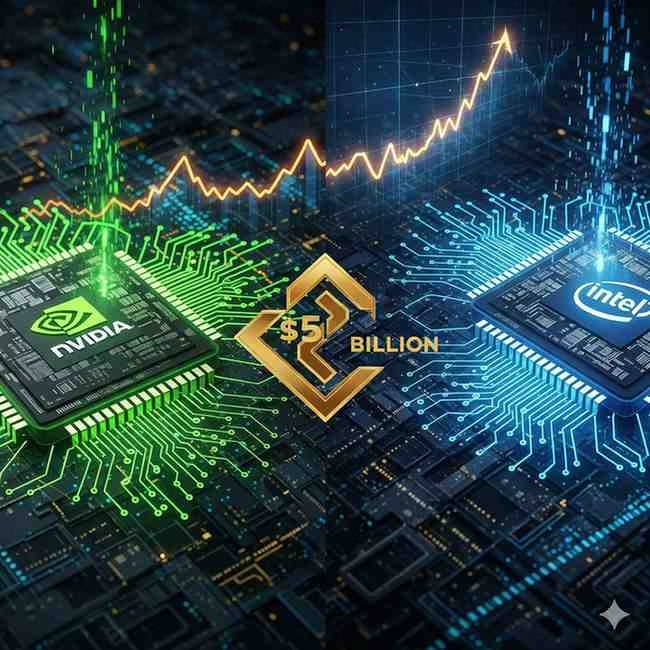
In a groundbreaking development that has sent shockwaves through global markets, Nvidia Corporation has announced a $5 billion investment in Intel Corporation, marking one of the most significant strategic collaborations ever seen in the semiconductor industry. The move instantly boosted Intel’s stock, with shares soaring sharply as investors reacted to the news with enthusiasm and confidence.
A Strategic Shift in the Chip Industry
This massive investment underscores Nvidia’s growing ambition to strengthen its influence in the global semiconductor supply chain. The partnership comes at a time when demand for AI chips, data-center processors, and advanced fabrication technologies is at an all-time high. By investing directly in Intel, Nvidia aims to diversify its manufacturing capabilities and reduce reliance on third-party foundries, including those in Taiwan and South Korea.
Intel, which has been aggressively expanding its foundry services under its IDM 2.0 strategy, stands to benefit enormously. The collaboration will likely accelerate Intel’s ongoing efforts to position itself as a leading chip manufacturer for external clients — including competitors like Nvidia.
Market Reaction and Investor Sentiment
Following the announcement, Intel shares surged as investors viewed the partnership as a powerful validation of Intel’s long-term potential. Nvidia’s move was seen not only as financial support but also as a signal of industry confidence in Intel’s manufacturing roadmap and technological resurgence.
The global semiconductor market responded positively, with shares of chipmakers, suppliers, and equipment manufacturers all trending upward. Analysts believe this deal could lead to new collaborations in AI acceleration, GPU-CPU integration, and advanced chip design — areas that both companies have been heavily investing in.
Why This Deal Matters
This investment has far-reaching implications for the global tech ecosystem. Nvidia and Intel, historically fierce competitors, may now collaborate more closely in AI computing, cloud infrastructure, and high-performance chip manufacturing. Such cooperation could reshape market dynamics and challenge existing foundry giants like TSMC and Samsung Electronics.
Moreover, as global governments push for semiconductor self-reliance, this partnership strengthens the U.S. chipmaking landscape. It represents a strong statement of technological unity between two of America’s most powerful semiconductor companies.
Expert Opinions and Future Outlook
Industry experts suggest that Nvidia’s investment in Intel is more than a financial transaction — it’s a strategic alignment that could pave the way for long-term collaboration. The move is also being interpreted as Nvidia’s effort to secure future chip supply, as the company’s AI-driven products continue to dominate global demand.
For Intel, the investment provides both capital and credibility. It signals that the company’s ongoing transformation — including heavy investments in AI, foundry services, and next-generation chip architecture — is gaining traction with industry leaders.
Conclusion
Nvidia’s $5 billion investment in Intel marks the beginning of a new chapter in semiconductor innovation. It demonstrates a strategic shift from competition to collaboration in an industry that powers everything from smartphones and data centers to electric vehicles and AI systems.
With both tech giants joining forces, the global semiconductor landscape is set for a major transformation — one that could redefine how chips are designed, manufactured, and deployed in the era of artificial intelligence.