United Kingdom — September 25, 2025
Two of Britain’s most established companies, the Co-operative Group (Co-op) and Jaguar Land Rover (JLR), are reeling from crippling cyberattacks that have disrupted operations, slashed profits, and sent shockwaves across supply chains. Analysts warn that these incidents could rank among the most damaging corporate cyber crises in recent memory.
🛒 Co-operative Group: Revenue Plunge & Customer Data Breach
- The attack & disruption
Co-op was hit earlier this year by a sophisticated cyber assault that forced the shutdown of critical IT systems. The breach impacted its retail food stores, funeral services, insurance operations, and legal arms. Stock shortages, payment failures, and service delays left millions of customers frustrated. - Customer impact
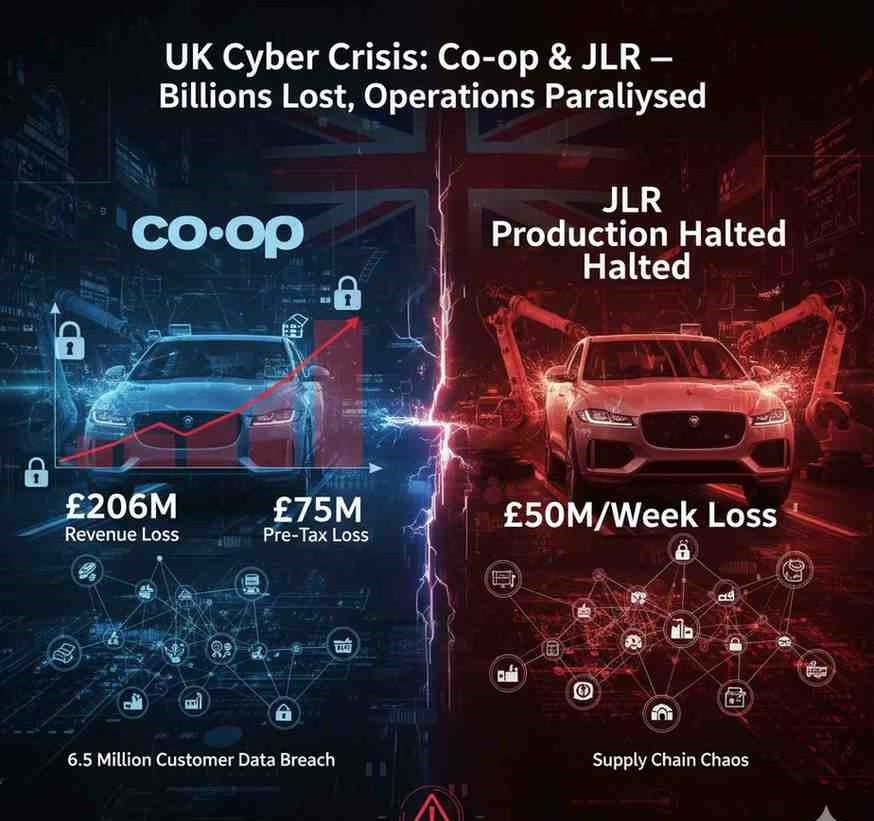
Personal data of 6.5 million members was reportedly compromised, raising widespread concerns about data protection and trust. - Financial damage
Co-op reported an estimated £206 million revenue loss in just the first half of the year, with operating profits sinking by £80 million. The group slipped into a £75 million pre-tax loss, compared to a modest profit last year. - Response & recovery
Leadership emphasized swift crisis measures and praised frontline staff for keeping essential services running, especially rural “lifeline” stores. Still, the company admitted its cyber insurance coverage was insufficient to shield against the full financial blow. The focus now shifts to system overhauls, security upgrades, and rebuilding customer confidence.
🚗 Jaguar Land Rover: Production Halt & Multi-Billion Risk
- Factories forced offline
Jaguar Land Rover’s UK factories have been offline since late August following a cyberattack that paralyzed production systems. The automaker has repeatedly extended the shutdown, with operations now expected to remain halted until at least October 1, 2025. - Financial shockwave
The shutdown is costing JLR around £50 million per week in lost output. Experts estimate total damages could exceed £2 billion, making it one of the costliest cyber incidents to ever hit the automotive sector. - Insurance gap
Alarming revelations suggest JLR had not finalized its cyber insurance coverage before the attack, leaving the company to shoulder most of the losses directly. - Supply chain & jobs
Thousands of suppliers depending on JLR’s just-in-time system are under heavy strain. Around 33,000 employees across UK factories have been sent home, creating ripple effects across regional economies. - Government response
UK authorities are exploring emergency relief measures to support suppliers and safeguard jobs, while JLR works to gradually restore operations once systems are secure.
🌍 Broader Implications
These twin crises highlight the growing vulnerability of global corporates to cybercrime:
- Huge financial exposures show that even established companies can be crippled within weeks.
- Cyber insurance gaps are proving costly, with policies either inadequate or absent.
- Supply chain fragility demonstrates how one attack on a major company can cascade across entire industries.
- Government involvement is increasingly necessary, as fallout impacts entire economies, not just individual businesses.
🔮 Outlook
Both Co-op and JLR face long roads to recovery. For Co-op, the priority will be restoring customer trust, strengthening systems, and stabilizing earnings. For JLR, the challenge lies in resuming production, managing supplier survival, and absorbing multi-billion losses.
These cases serve as a warning: in today’s digital-first economy, cybersecurity resilience is as vital as financial stability. Companies worldwide are now reassessing their defenses, insurance coverages, and crisis management strategies to avoid becoming the next headline.