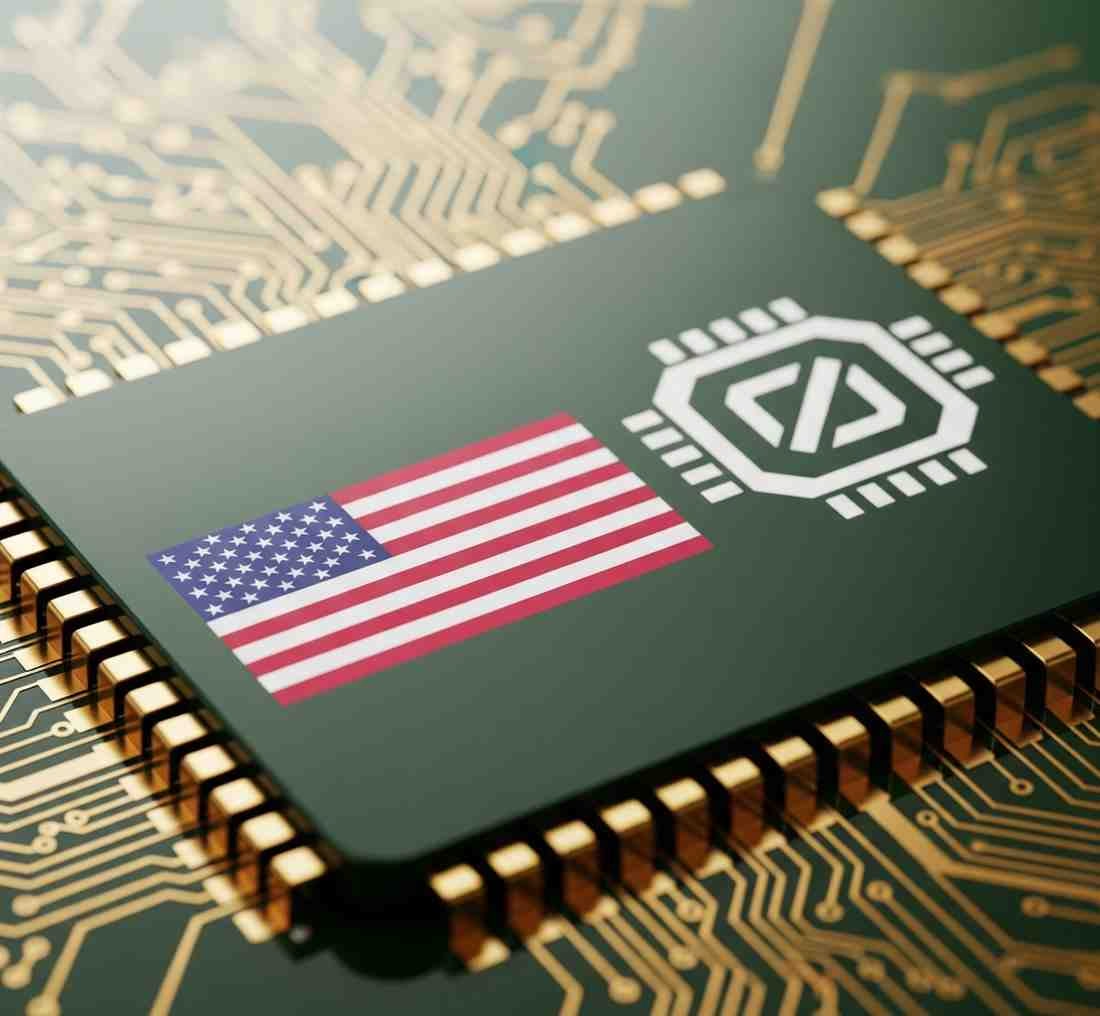
In a move that stunned Wall Street and Silicon Valley alike, the United States government has taken a nearly 10% stake in Intel Corp., instantly becoming one of the chipmaker’s largest shareholders. The deal, finalized late Friday, is valued at $8.9 billion and marks one of the most unorthodox interventions in corporate America in decades.
When combined with $2.2 billion in earlier Chips Act subsidies, Washington’s backing of Intel now totals a staggering $11.1 billion. Unlike traditional government bailouts or grants, this agreement gives the US Treasury 433.3 million shares of Intel common stock — though without a board seat, voting rights, or direct governance. The government, for now, is a passive but powerful owner.
🔹 How the Deal Happened
According to both White House officials and Intel’s leadership, the agreement grew out of a heated face-to-face between President Donald Trump and Intel CEO Lip-Bu Tan. Trump, who had just weeks ago criticized Tan for alleged conflicts of interest, abruptly flipped his stance after realizing the scale of Intel’s role in domestic chip production.
“I said, ‘You know what? I think the United States should be given 10% of Intel,’” Trump recalled of the meeting. “And he said, ‘I would consider that.’ And I said, ‘Well, I’d like you to do that.’”
Within days, Commerce Secretary Howard Lutnick helped hammer out the fine print, paving the way for Friday’s announcement.
🔹 Why Intel? Why Now?
For Washington, the reasoning is clear: semiconductors are the oil of the digital age. Intel remains one of the very few American companies capable of producing advanced chips on US soil at industrial scale. Recent shortages exposed just how vulnerable the US supply chain was, with everything from cars to iPhones to military hardware disrupted.
“This is not just about economics — it’s about national security,” a senior White House official explained. “If America can’t make its own chips, it can’t defend its own future.”
Intel is currently pushing forward with a $100 billion expansion plan to build and modernize fabs in Arizona and Ohio. The Arizona factory is expected to begin high-volume production later this year, while Ohio’s project has faced repeated delays. The new cash infusion could be the lifeline Intel needs to stay competitive with rivals like Taiwan Semiconductor Manufacturing Co. (TSMC) and Samsung.
🔹 The Risks: A Bold Bet With Taxpayer Money
But the move is far from risk-free. Intel has spent the last decade losing ground, plagued by missteps, manufacturing delays, and a reputation for lagging behind its rivals. Wall Street analysts were quick to note that money alone cannot fix Intel’s problems.
“Besides money, Intel needs customers,” warned Bernstein analyst Stacy Rasgon. “Funding a buildout with no customers probably won’t end well for shareholders — and now, the US government is one of those shareholders.”
Intel’s chip-manufacturing division is still seen as inferior to its Asian counterparts, and building world-class fabs will take years. Unless Trump can help line up new clients, the government’s equity could quickly turn into a liability.
🔹 A Sweetener in the Deal
Hidden in the fine print is another intriguing clause: Washington secured a five-year warrant giving it the right to buy an additional 5% of Intel stock at $20 a share — but only if Intel loses majority ownership of its chip-manufacturing arm. It’s a safeguard that ensures the US government retains leverage if Intel’s future control comes into question.
🔹 Industry Reactions and Trump’s “Salesman Role”
Despite skepticism, industry partners rallied behind Intel as the deal was announced. Microsoft, Dell, HP, and Amazon AWS all pledged to support Intel in strengthening the US chip supply chain. “The industry needs a strong and resilient US semiconductor industry, and no company is more important to this mission than Intel,” said Michael Dell, CEO of Dell Technologies.
Some analysts even suggested that Trump himself could play a strange but pivotal role as Intel’s chief salesman, nudging major corporations to commit to Intel-made chips. Dan Morgan, a veteran portfolio manager at Synovus Trust, put it bluntly: “Trump kind of becomes your salesman.”
🔹 A New Kind of Statecraft
The Intel stake is part of a broader pattern. Trump has already negotiated a “golden share” in Nippon Steel’s acquisition of US Steel, giving him unusual decision-making power, and announced a controversial revenue-sharing arrangement with Nvidia and AMD on AI chip sales to China.
Taken together, these moves signal Trump’s new brand of economic statecraft: not just funding companies, but embedding the government directly into corporate ownership and decision-making. It’s a radical shift that could redefine the relationship between Washington and American industry.
🔹 The Big Question: Masterstroke or Misstep?
For Intel, the deal offers an immediate shot of liquidity and credibility. For Trump, it represents a bold new experiment in mixing national security, industrial policy, and Wall Street investment.
But will it pay off? That depends on whether Intel can translate billions in fresh capital into real technological breakthroughs — and whether customers are willing to bet on Intel again.
For now, markets are cautiously optimistic: Intel’s shares surged 5.5% to $24.80 after the announcement, though they slipped slightly in postmarket trading. Investors, like taxpayers, are watching closely to see if this high-stakes gamble turns into a landmark win — or a very expensive mistake.